Monday, 20 December 2010

something I wrote before.....

found a piece of writing from last year. How...I used to be!!!
Here is it:


  "                                        Tjibaou Cultural Centre
  "On the southern pacific island of New Caledonia, along the point of the cape between Magenta Bay and a mangrove-surrounded lagoon, a range of amazingly fascinating constructions are displayed over the jungle, presenting its attractiveness and calling up people’s imagination. So enigmatical they are that people are baffled whether these objects are survival from the ancientry or they come from the aftertime: they seem to be made of fabric, yet extremely over sized; they look like radio-telescope, but they are wooden. Also, the buildings tend to express some remaining legendary sense of the modern society with the tall lathing pointing vertically to sky, likely showing some awe to the gods and the power of universe. These buildings designed by Renzo Piano and named after Jean-Marie Tjibaou, the New Caledonian leader who died in 1989 for independence of his country from the French government, is the Tjibaou Cultural Centre.    
  "While exhibiting a very modern feel, the Tjibaou cultural centre yet still evokes the native Kanak culture of New Caledonia. The Center itself is similar to that of the villages the Kanak tribes live in.  It is constituted by 3 villages made up of 10 units, which are called 'case' in French, of varying sizes and different functions (exhibition spaces, multimedia library, cafeteria, conference and lecture rooms).  The cases are linked by a long, gently curving enclosed walkway, reminiscent of the ceremonial alley of the traditional Kanak village. Or, rather than 3 villages, they are more like shrines out spreading along the pathway. It is like the the unwinded Pantheon: the shrines with in the thick remaining walls of the pantheon have broken the fetter and arrayed themselves to the side of the road, and was unmindfully woven into an Acropolis-like island scene.  These isolated highly standing, then clustered round cases have successfully released the symbolism which has long been inhabited. Their tremendous scale, as well as their independent existing, is enough to distinguish the Tjibaou Cultural Centre from the concentrated commemorative constructions and to make them the individual troop of monuments of Tijbaou, while their clustering form can be a new symbol of the Kanak village culture.                  
  "The identity of the Kanak is not only manifested through the form of the building but also through the relationship to the local circumstance. Located on the peninsula between the stormy Pacific Ocean and the calm lagoon, the design of Renzo Piano takes advantage of the prevailing winds come off the ocean through its natural ventilating system--the top of the wood-made outer façade are like comb that filters the wind into a second layer of glass louvers which can open and close. When ‘Alize’—monsoon in native language-- flows through it, the building will croon. Meanwhile, the buildings are well merged with its landscape. The vegetal crust of the buildings, like it of Kanak adobe and other facilities, establish a close relationship with the surrounding vegetation both visually and practically. The Kanak pathway that winds through the dense natural vegetation, traditional Kanak ceremonial grounds with traditional huts, an outdoor auditorium and residences for visiting artists, lecturers, scholars and students, as well as the main building, integrate themselves and take advantage of the natural beauty of the site."

something about traditional Chinese Architecture

Chinese architecture is work of earth and stone. Wood and Earth have always been the major material of Chinese architecture throughout its history, one reason of which is the gentle climate in most regions of China; for this reason, it is unnecessary to build solid stone shelters to get rid of the wicked weather. As a principle of traditional Chinese architecture, the use of wooden framework has been carried through all the time. The skeleton consisting of pillars and beams transfers the gravity load of the upper part of the building to the ground, thereby ensuring the stability of the whole structure, while the wall only serves as curtain to separate the inner space and outer space. As a result, the building will not fall down even if the wall is ruined.     

 Traditional Chinese buildings usually appear as groups, and each of the single is highly standardized. Despite its scale, every building is constituted by 3 primary parts including step base, Main body and roof: At the bottom is the step base made of bricks or stone, with several steps leading onto a platform on which the main body is built. The main body is structured by wood pillars, accompany with doors and windows amongst them. Above the main body is the roof which is trussed by wood members and covered by black or colored glaze tile. The plan of most buildings are rectangular, however, in some situations, it can also be square, eight-square or round.  The roof also has different forms, and every form can have single or double eaves. wood structure     

  Usually, Chinese architecture have plane layout, and very keen regard of composition of the building group has been shown in it, the fundamental rule of which is symmetry, multilayer and connotation. Except some special ones such as gate tower of drum tower, single buildings are seldom exposed completely in sight. Every building group has at least one courtyard, therefore make the combination variable. The layout is usually symmetric; central yard and central axle are widely adopted. However, as an exception, the layout of gardens is much freer.
   
The corbel bracket, which is called Dougong in Chinese, is a particular component of Chinese architecture. It is a system of brackets composed of square blocks crossing one another and inserted between the top of a column and a crossbeam. Originally, Dugong was installed at the head of the pillar to connect and support the beam and was used as the very crucial part to extend the roof, and it gradually developed in to a whole layer between the pillars and the roof truss, and then became an important decoration and the representative symbol of Chinese architecture.  examples of Dougong
 
 
  In Northern China, the typical colors of buildings are red, green and yellow; theses colorful paint are often applied to bring the liveliness as a balance against the deserted environment, while in Southern areas, the houses are usually painted white and black. This is because of the different circumstance in different regions.   

How to Grow a House

"They say only two kinds of person would expect a house to grow from the land like bamboo: kids and fools. I'm aready 32, no longer a kid, so the only possibility is that I'm a fool."

The one said this has eventually get his dream become true. He has managed to grow a house in his home village in Anhui Province, China.

The house has two stories. the first floor includes a traditional kitchen, a toilet,  and the second floor 3 bedrooms and a roof garden. It truely grows from the land, for all its materials are extremely local: the wall is made from the scree and the earth just infront of the door, mixed with 5% lime and tamped with modle; the four major beams and the second floor are fast-grown firry; the first floor is the local slate; the two-layer roof is insulated by bulrush and chaff. When not needed and pulled down, it goes back to the land under our feet, like plants.

Plants breath, so does the house. The 33cm earth wall absorbs the rain, and emit the vapour in sunshine; it keeps the temprature like the air conditioner. There is a well in the parvis, which not solely supply the drinking water. In summer, it is pumpted up to the roof garden and comesback to the gound to flush the toilet. the waste of bamboo products are burnt for heat in winter. The asphalt felt roof makes it bearable for the firry beam. All materials cost about 5000GBP.


Sunday, 19 December 2010

Courage of Rethinking

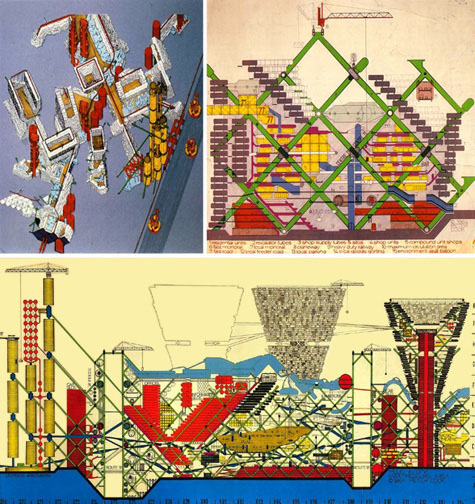
Archigram was formed in 1960th, with initial members including Peter Cook,Warren Chalk, Ron Herron,Dennis Crompton,Michael Webb and David Greene. Archigram is also the title of their magazine, the first issue of which being publised in 1961, when Corbusier be awarded the golden medal by AIA, and Modernism still be the main stream of the world.

The famous projects of Archigram, such as Walking City,Plug-In City, Instant City ect, were all based on drawing and full of the characteristics of Si-Fi and Mechanism, and that's what it is defined to be: Mechanical Futurism.                                   Walking City
Plug-in City
Instant City

But that seems to be our biggest misunderstanding of Archigram.

The spirit of Corbusier is that he had captured the feature of his era and transfered it into Architecture and made Architecture fit the time. But he himself is essentially a traditional 'Architecturalist', who believes in the contrast between solid and void, and the order of space. Similarly was Mies Van der Rohe, who has catched, yet was limited by his age. Once the age passed, their spirit passed.

What is the difference of Archigram, if its spirit is but Mechanical Futurism?

The image of the future is more or less related to the reality, and a tiny incident of human's technoloy will change it. Science Fiction becomes out easily, not to mention the Science Fiction of 60th. 

We are still talking about Archigram not because of its Mechanical Futurism, not being fascinated by designing a faster elevator. Then what ever makes it different? I think the most essential spirit of Archigram is to require us to carefully rethink about everything.

Everyone must live in an artificail world constituted by architectures. Being the builders of this world, it is irresponsible not to think why the world have to be like this, why wall must be a wall, door must be a door, why window must have a frame. Actually all the Architectural theories after the Modernism are substantially based on this spirit of rethinking.

Mike Webb, one of the Archigram members once said that: "When you are looking for a solution to what you have been told is an architectural problem-remember,the solution may not be a building."

Architecture should include a wider range and some more open minds. If there's already been enough people doing the boring jobs, why join them?

So, HAIL to these daring challengers against the authority in 1960th.


Friday, 22 October 2010

9 Square Grid House


I actually joined this project halfway and was in charge of the detail, specifically of the walls and the floor, which is the most delicate part as they actualize the major functions of the house. Therefore, making the model of this part became quite tricky, but I survived it after all.

Designed for a couple without children, the 9 square grid house is located in a commuter suburb of Tokyo, an active earthquake zone. The house is very simple, basically the only two furniture walls support the roof, leaving the interior free of load bearing structure. 

The floor can be divided into maximum 9 squares by the sliding boards according to usage. tracks are installed in the floor and the ceiling for the boards.


The unused boards can be stored in the "pockets" behind the wall.

The walls also has function of storage. Steel studs are applied to strengthen them so that the can bear the roof.

Encountering THE Rex

Such a remarkable event, at least for me, happened unexpectedly, as always, at a random moment. The conditions that allows it to happen were actually simple: a boring afternoon, three boring persons (I prefer the word "person") and most importantly, a fairly attractive exhibition. The occasion was just right, and all happened.

Have to admit that I knew nothing about the famous V&A Museum until going to this exhibition, i.e. I had totally no backgrounds of this project, such as precedents clients brief blablabla... except an instant glance and a superficial impression of the site, which gives me an opportunity to appreciate the works in a more intuitional way, and that turned out to be an enlightening experience and made me rethink of the standard of a "good" architecture.

The core I want to talk about is this:
Impression
Proposal of V&A Dundee by REX

Impression
Model with Lightening

Model
More Detail

Model
More More Detail

yet my ability of language doesn't allow me to describe it completely. Like a congealed splash or the crystal grown out of the water, it seems be striking some prime sense rooted in my consciousness and subconsciousness despite any rule, theory, ism...and analysis.

A DIRECT IMPACT

Source of images: http://vandaatdundee.com/your-future/shortlist/rex/