The famous projects of Archigram, such as Walking City,Plug-In City, Instant City ect, were all based on drawing and full of the characteristics of Si-Fi and Mechanism, and that's what it is defined to be: Mechanical Futurism.
 Walking City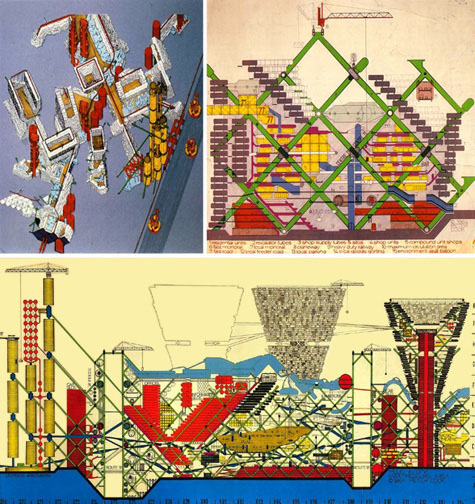
Plug-in City

Instant City
But that seems to be our biggest misunderstanding of Archigram.
The spirit of Corbusier is that he had captured the feature of his era and transfered it into Architecture and made Architecture fit the time. But he himself is essentially a traditional 'Architecturalist', who believes in the contrast between solid and void, and the order of space. Similarly was Mies Van der Rohe, who has catched, yet was limited by his age. Once the age passed, their spirit passed.
What is the difference of Archigram, if its spirit is but Mechanical Futurism?
The image of the future is more or less related to the reality, and a tiny incident of human's technoloy will change it. Science Fiction becomes out easily, not to mention the Science Fiction of 60th.
We are still talking about Archigram not because of its Mechanical Futurism, not being fascinated by designing a faster elevator. Then what ever makes it different? I think the most essential spirit of Archigram is to require us to carefully rethink about everything.
Everyone must live in an artificail world constituted by architectures. Being the builders of this world, it is irresponsible not to think why the world have to be like this, why wall must be a wall, door must be a door, why window must have a frame. Actually all the Architectural theories after the Modernism are substantially based on this spirit of rethinking.
Mike Webb, one of the Archigram members once said that: "When you are looking for a solution to what you have been told is an architectural problem-remember,the solution may not be a building."
Architecture should include a wider range and some more open minds. If there's already been enough people doing the boring jobs, why join them?
So, HAIL to these daring challengers against the authority in 1960th.

No comments:
Post a Comment